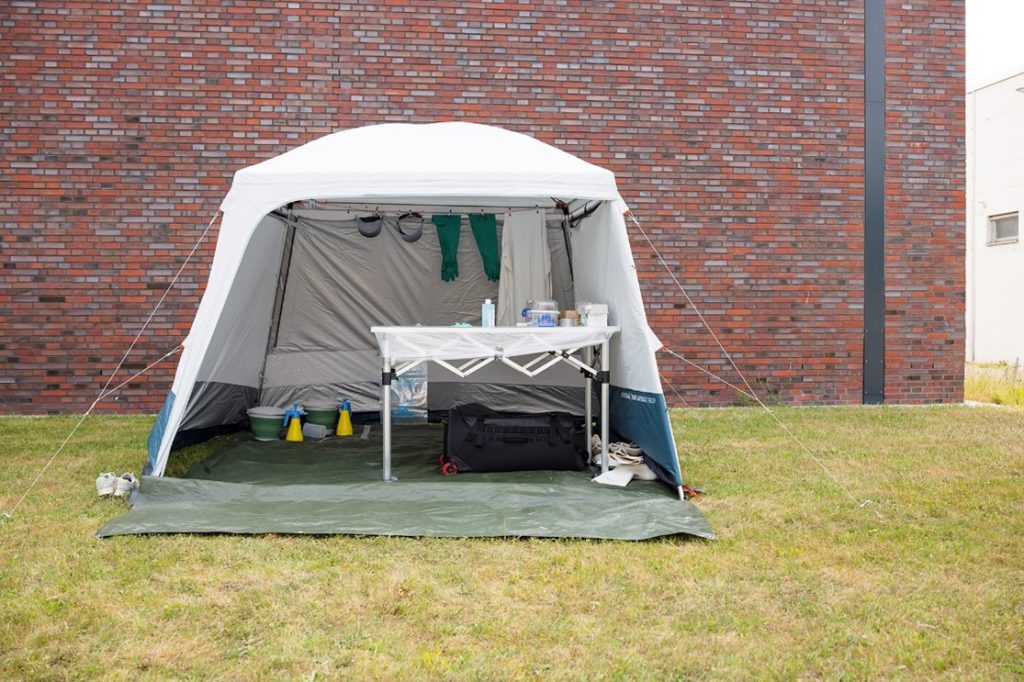
Building on the success of its debut field mission in Austria, MOBILISE has taken its mobile laboratory operations across the border to Germany. This latest deployment served as a comprehensive test of the project’s operational flexibility and technical capabilities. BNITM and FLI teams worked on integrating mobile lab functions into existing outbreak monitoring systems, refining workflows for rapid molecular diagnostics, strengthening communication between field teams, and ensuring closer collaboration with local authorities in outbreak response planning.
© FLI/Mandy Jörn
Setting the Stage on the Isle of Riems
After concluding the Austrian mission on 16 May, the MOBILISE Green Lab travelled to the Isle of Riems, home to the Friedrich-Loeffler-Institut (FLI), arriving on 22 May. Preparations included the development of a detailed fumigation plan, ensuring that high biosafety standards would be maintained throughout the operation. Field activities commenced on 9 June and continued for two weeks.
Objectives and Milestones of the German Field Mission
Authorisation and regulatory approval
The mission began with inspections by the Veterinary Office of Vorpommern-Greifswald and the State Office for Agriculture, Food Safety and Fisheries of Mecklenburg-Western Pomerania (LALLF). This was a key step to secure official approval for working with low- to moderate-risk pathogens, specifically for the analysis of wild bird faecal samples for avian influenza. The authorisation, granted on 16 June, permitted the handling of non-inactivated swab samples within the glovebox.
Establishing Avian Influenza Diagnostics
With the green light from authorities, the team established molecular detection methods for Influenza A and its subtypes, using reference material from the National Reference Laboratory for Avian Influenza. The RT-PCR protocols were successfully implemented, and the in-house diagnostic methods developed at FLI are now available for use across the MOBILISE project.
Training and confirmation of workflows
In order to consolidate the procedures, they were carried out several times in the wing laboratories, and tents were set up for sample collection and subsampling of veterinary samples, with the procedures demonstrated there. After approval by the authority, also BSL2 work using the glove box for inactivation of samples could be trained.
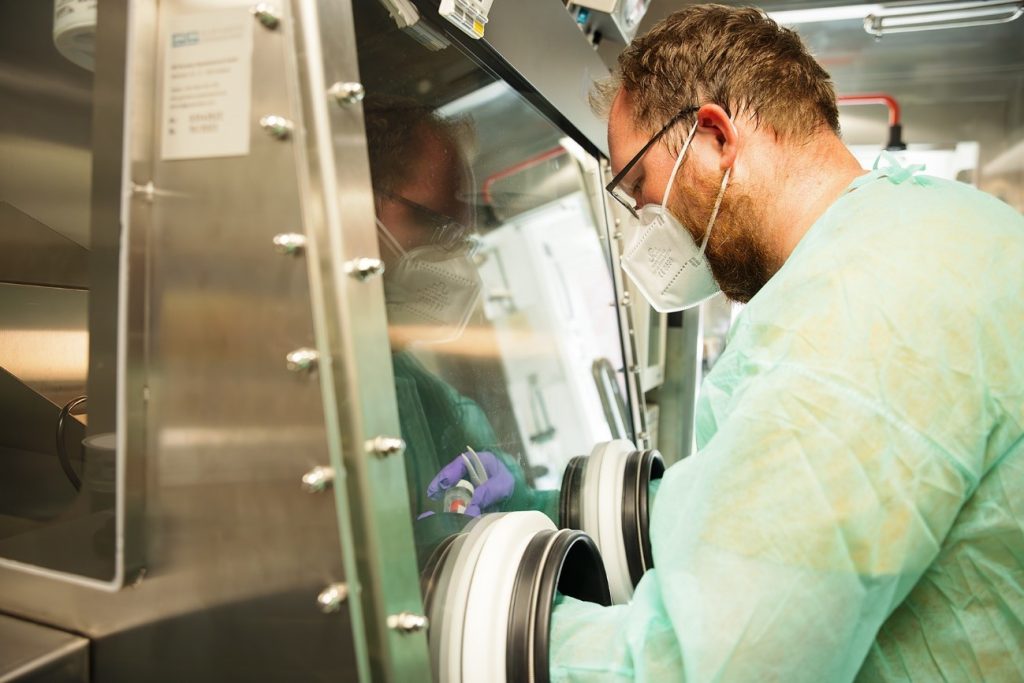
© FLI/Mandy Jörn – inactivation of samples
Field sampling and results
Field sampling took place on the Isle of Riems and at the Lubmin pier, a place near the city of Greifswald, in line with local guidelines and permits. Both inactivated swabs and environmental faecal samples were analysed. While no Influenza A was detected, validation tests using original material spiked with inactivated reference viruses confirmed that even challenging sample types like avian faeces could yield reliable results. Potentially infectious dry swabs, stored until authorisation was in place, have been processed to establish a full workflow for inactivation and analysis. Results from both sample types will be reported to the relevant authorities.
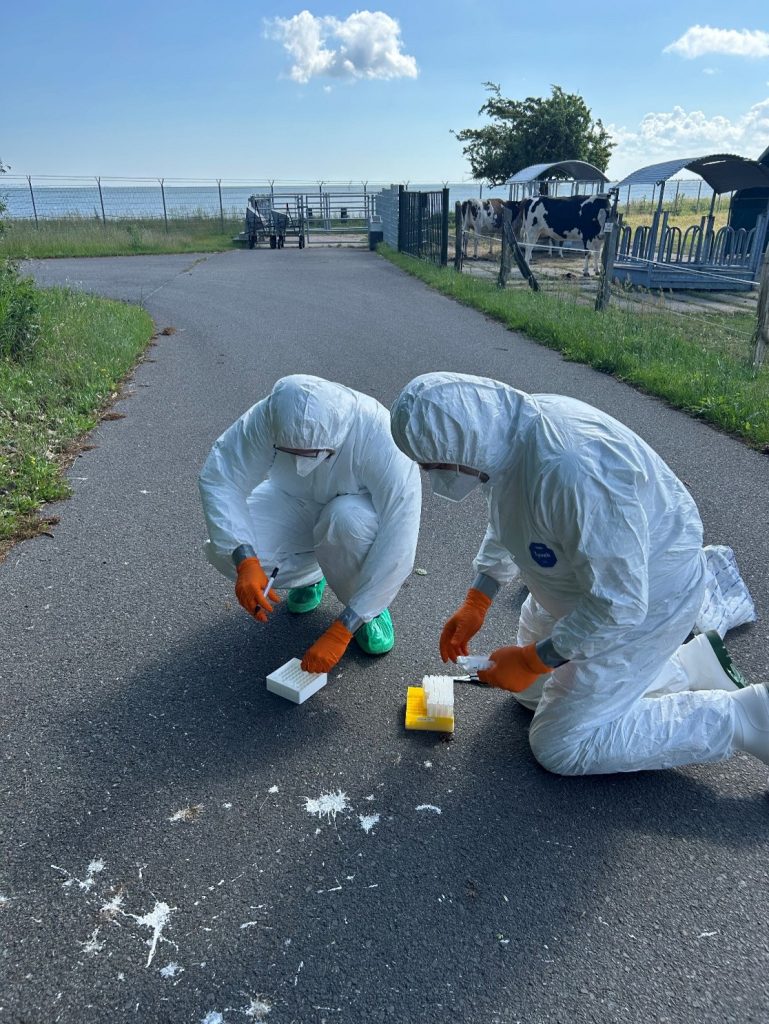
© BNITM/Aryse Melo – Sampling on Isle of Riems under outbreak conditions
Expanding diagnostic capabilities
The mission also broadened the lab’s diagnostic range. RT-PCR protocols for Oropouche virus, Chikungunya virus, and West Nile virus were successfully demonstrated, alongside an ELISA test for Rift Valley fever virus as a proof of principle for future work in Tanzania. Initial nanopore sequencing of West Nile virus was launched, with results pending.
Biosafety and decontamination
Finally, biosafety procedures were thoroughly tested. The autoclave and wastewater sterilisation system were qualified for BSL-2 operations, and a four-step fumigation protocol was developed to ensure safe decontamination after deployment.
Recap: MOBILISE Field Trial in Germany
Thanks to the support and excellent cooperation with local authorities, the Department of Experimental Animal Facilities and Biorisk Management (ATB) and the technical service at the Friedrich-Loeffler-Institut, it was possible to establish and test relevant detection methods for highly pathogenic zoonotic viruses during the time spent on the Isle of Riems. Besides the establishment of several molecular biological and serological diagnostic methods, the implementation of the workflow for the detection of avian influenza viruses (sample collection – inactivation – detection by RT-qPCR – documentation) was an important milestone. Furthermore, the drafting of the fumigation protocol and the qualification of the laboratory autoclave will play a very important role in the future work of the laboratory, even after its trial phase.
Looking ahead
With the German field mission completed on 20 June, MOBILISE has once again proven the versatility and readiness of its mobile laboratory concept. The experience gained and workflows refined on the Isle of Riems will directly strengthen the project’s capacity to respond to future outbreaks – both in Europe and beyond. The next challenge awaits in Greece, where the team will continue to put its capabilities to the test.
Want to learn more about Friedrich Loeffler Institute? Visit:
- 🌐 Website: https://www.fli.de
- 💼 LinkedIn: https://www.linkedin.com/company/friedrich-loeffler-institut
- 📘 Facebook: https://www.facebook.com/friedrich.loeffler.institut